Aligned with the UAE National AI Strategy 2031 and the 2026 mandate to move half of government operations to agentic AI
We change the mindset of owners and top executives at companies with $50B+ in total revenue, so they are ready for AI transformation. AI gets better every two months, and business processes stay one step behind. Companies spend millions on useless projects. The real limit is in our heads: in how we think about AI and about our own expertise. This is a method for raising the productivity of intellectual work.

Author of the hidden digital artefacts method · author, Digital Thinking and Digital Knowledge
Expert, Moscow School of Management SKOLKOVO — business school with EQUIS and AMBA accreditation
Financial Times 2022
#32 European Business Schools · #21 Executive Education, Custom · #50 EMBA worldwide
years as a top manager in large companies, including Chief Digital Transformation Officer
programmes delivered · 700+ hours of teaching every year
industries: banking, petrochemicals, insurance, airports, real estate, pharma, retail, food, heavy machinery, education
Where the method has already worked
The UAE names its priority sectors in the National AI Strategy 2031, in Operation 300bn and in We the UAE 2031. Our 2,000+ implementation cases come from large corporations in the same sectors. Whatever your sector, there is a case here that looks like your process.
AI Strategy 2031
Cases in oil and gas, petrochemicals, fertilisers and chemicals: plant maintenance planning, procurement, sales of by-products, technical documentation.
AI Strategy 2031
Cases in airport infrastructure, a sea port, road freight and road construction: dispatching, tender documents, claims handling, planning of works.
AI Strategy 2031 · Operation 300bn
Cases in pharmaceutical manufacturing and pharmacy retail: regulatory dossiers, assortment, procurement, customer service. A programme for public healthcare leaders is prepared with a regional government.
Operation 300bn
Cases in heavy machinery, food production, packaging materials: engineering documentation, quality control, production planning, supplier work.
We the UAE 2031
Cases in banking and insurance: underwriting, claims, credit files, compliance, customer communications. Measured hours before and after.
We the UAE 2031
Cases in mobile operators, video streaming, IT services and real estate development: content operations, customer support, sales analytics, project documentation.
Government mandate · 2026
50% of federal services through AI agents within two years. Our programmes cover phases 1 to 3 of that roadmap: picking the agentizable workflows, making them executable, training the supervisors. Cases in procurement and tenders, public healthcare, document-heavy approvals.
2,000+ implementation cases from large corporations. Whatever your industry, there is a case here that looks like your process.
Cases in oil and gas, petrochemicals, fertilisers: plant maintenance planning, procurement, sales of by-products, technical documentation.
Cases in airports, a sea port, road freight, road construction: dispatching, tender documents, claims handling, planning of works.
Cases in pharmaceutical manufacturing and pharmacy retail: regulatory dossiers, assortment, procurement, customer service.
Cases in heavy machinery, food production, packaging materials: engineering documentation, quality control, production planning.
Cases in banking and insurance: underwriting, claims, credit files, compliance, customer communications.
Cases in mobile operators, video streaming, retail chains, real estate development: content operations, customer support, sales analytics, project documentation.
For the people who set the direction. For government and state-owned companies, where security and resilience come first. For the people who run the divisions. For the people who will teach the method inside the company. For entrepreneurs in an open class.
01 · Programmes
Track 1
For owners, CEOs and the management team. Two days on your own company: where AI will make money for you, where it is a waste, and what kind of thinking the leadership needs so the transformation does not stall at the pilot stage.
A closed session for the people who sign the decisions. We take the strategy of the company and run it through one question: where does the speed of the whole business depend on thinking work that nobody has written down. The answer sets the sequence of AI investments for the next year.
Track 2
For leadership and senior staff of ministries, agencies and state-owned companies. The same method, applied where the first question is safety before speed: which data can leave the contour, which decisions stay with a person, and how the process keeps working when the model, the vendor or the budget changes.
For the Director General, the Internal AI Steering Committee and the Office of the Chief AI Officer of a federal or local entity. The mandate is set: half of government services through AI agents. The open question is which workflows are agentizable, how to make them executable for an agent, and where the final human review stays. The programme answers it on your own processes, inside your own contour.
In a commercial company the measure is hours saved. In government the measure is a process that keeps working: under audit, under a change of vendor, under a failure of the model. So the method starts with the hidden work, as everywhere, and adds two filters before any technology is chosen: where the data goes, and who answers for the decision.
Where it sits in the two-year roadmap: phases 1 to 3. Choosing the pilot workflows and checking data readiness, deploying internal-facing agents on documents and analysis, training the supervisors at scale. Orchestration layers and sovereign cloud are built by your infrastructure partners. We make the processes ready for them.
Runs in the organisation's own environment, with its own data and its own IT and security teams in the room.
Track 3
For the head of a division and the people who own its processes: sales, finance, operations, HR, legal, marketing. The division's real processes are the material. By the end the division has its own map of where agents go in, and its first agent designed.
Runs after the business divisions have done their work. The business formulates, the technology side builds: how to take division prototypes into production safely, how agents integrate with corporate systems, and what APIs and data look like when agents are the users.
Track 4
The company takes the method and runs it itself. Senior analysts learn to find hidden thinking work in a process, describe it as artefacts and hand it to the machine. The corporate university receives the programme, the materials and the right to run it for its own people.
The order is set by the business. Owners and top executives set the direction. Division heads rebuild their processes. Technology teams take the result into production. Senior analysts and the corporate university carry the method further without us.
Every corporate track leads to implementation support: 8–12 months of regular sessions with the team until the effect is measured.
Track 5
An open class: owners and founders from different industries in one room. Each works on their own business, and the room itself is part of the result. You see how the same method lands in a clinic, a factory and a trading company, and you leave with people who are solving the same problem as you.
In a closed corporate session everyone shares one context, so the method goes deep into one company. In an open class the contexts differ, so the method shows its range: the same five steps work in every industry.
The second result is the room itself: networking between owners from different industries. A logistics owner hears how a clinic solved the same bottleneck, a manufacturer finds a partner in retail. Entrepreneurs come for the method and stay for the peers.
Online runs keep the same structure: your own task, your own prototype, small working groups between sessions.
02 · Experience
2,000+ AI cases in ten industries show the same picture. There are three strategies. We work with all three, and we put the weight on the last two.
Each person works faster with an AI assistant. Useful, but the process itself stays the same, and the effect stays inside one head.
One step in the process is given to the machine. The step gets faster, hours are saved, the effect can be measured. This is where most companies get their first real result.
Sequential processes become parallel processes. Waiting disappears. Productivity grows many times over, not by a few percent. This is the biggest effect. But how to do it?
The answer is a method, and it starts with seeing the hidden work.
You're not behind on AI. Your process is behind.
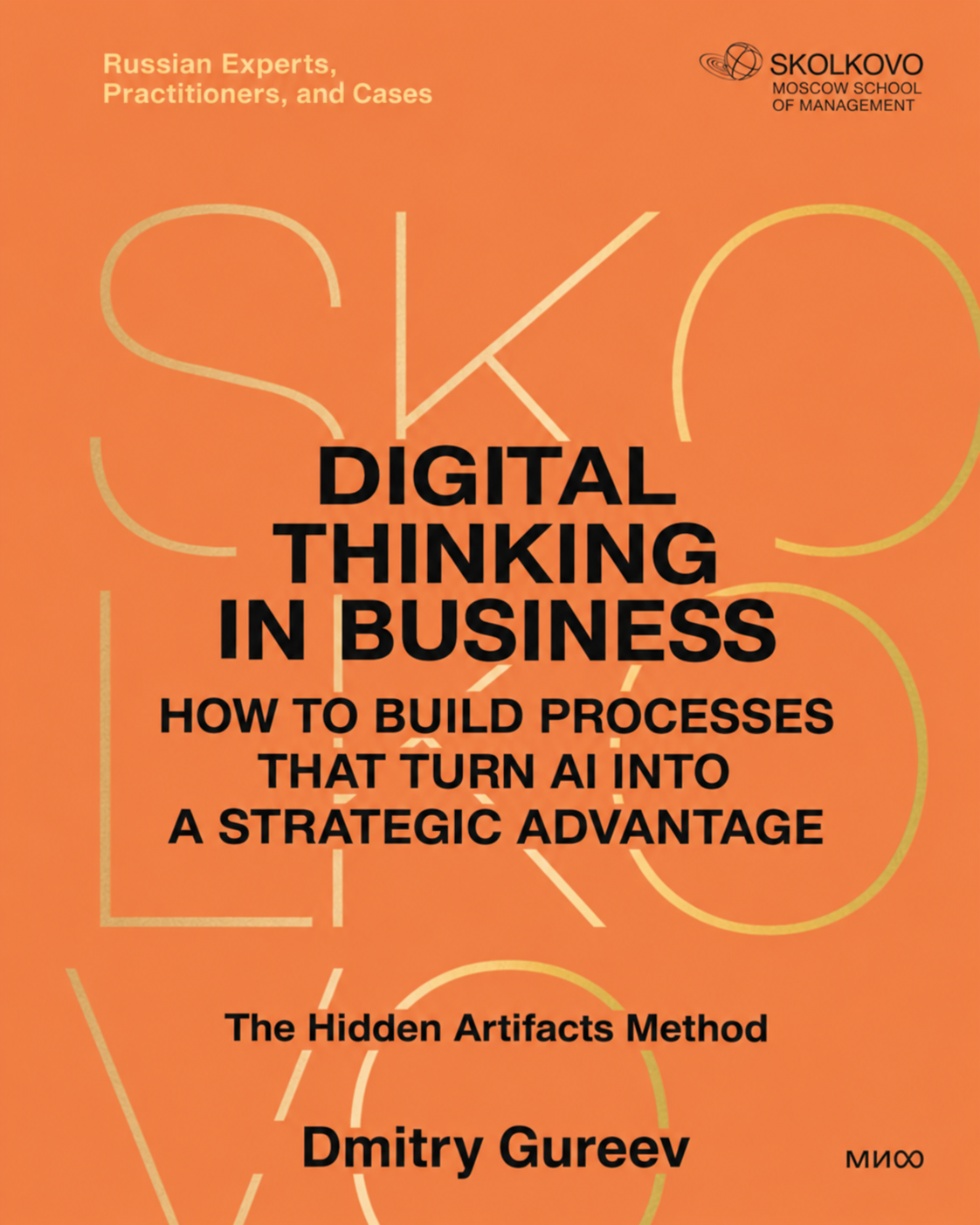
The Hidden Artifacts Method · Russian edition: MIF, SKOLKOVO Business Review series, 2026 · English edition coming to Amazon
A business novel about uncovering hidden bottlenecks and turning AI investment into measurable business results. Published in Russian by MIF in the SKOLKOVO Business Review series (2026), the book sold nearly 5,000 print copies in its first six months and has become popular among corporate readers. The English-language edition is coming to Amazon for worldwide distribution.
The problem is not that we cannot see the solution. The problem is that we see the problem the wrong way.
Book two · after Digital Thinking in Business
AI gives an answer in seconds, and next to it any expertise starts to look available in one evening. For some professions this is already true. So what is human knowledge then, and how can AI agents amplify it?
Knowledge is the ability to see the nature of things: what your work is made of, and how it connects to other people in the process. Digital knowledge is knowledge dissolved into human-plus-machine teams, where the human's role is the operator of meaning.
The bottleneck is no longer the tool. It is the knowledge nobody wrote down.
03 · The method
Work is a chain of artefacts: input → thinking → output that someone uses next. Each output is a handoff to the next person, like in a relay race. If an artefact lives only in an expert's head, it is hidden. While it is hidden, you cannot manage the process and the machine has nothing to work with. Once it is written down — as text, a table, a rule — you can give it to a person, an assistant or an agent.
Find the traffic jam: the part of the process that slows everything down the most.
Write down what goes into this part and what comes out. A result is a deliverable: something you can print and hand over to a colleague or to an AI worker.
Write down the knowledge, skills, tools and small decisions the expert uses to create each part of the result.
Expert's logic → a method anyone can repeat → a technology: an algorithm, machine learning, a language model or an agent. The type of work decides which one.
Give the chosen operations to the machine. The knowledge and tools stay in the company. This is what makes scaling possible.
Start with a question most vendors skip: does this task need AI at all? There are four types of thinking work and four types of tools. If a simple rule solves the task, AI here is expensive and useless.
Connecting an AI tool can be learned in one evening. These three skills cannot.
See the difference between visible actions and the hidden thinking before them. Notice the moment when information leaves the system and goes into someone's head.
What does this step produce, as a deliverable — and who uses it next?
Find the 5% of data that a decision really depends on. Name the result as a deliverable that can be printed and passed on.
What exactly in the input decides the result?
Start from the money result and go back: actions ← decisions ← artefacts ← data. See which task is for an algorithm, which for machine learning, which for a language model, and which for an agent.
Does this need AI at all — or is a simple rule enough?
| What others do | What this method does |
|---|---|
| Digital trail | Tools that learn from email, tickets and chats see only what was written down — the result. The risk assessment, the idea, the quality criterion never get there. This method finds exactly that gap between the steps. |
| «People hide their know-how» | People want to explain and cannot: nobody describes their own work to themselves. So we do not ask the expert to describe the method. We put the machine in a dialogue with the expert, round after round, until the machine's output matches the expert's. At that moment the skill is captured. |
| «Map the tacit knowledge» | Everyone names this step. Nobody gives a procedure for it. Here the procedure is the product, with a clear stop criterion at every step. |
| Promised effect | Measured effect. Every solution must raise labour productivity, and it does so by raising the productivity of thinking work: fewer hidden steps, less time from input to result. Each case is measured before and after. The price of tokens is part of the calculation: a solution that eats more in tokens than it saves in hours is not a solution. |
04 · The thesis
Goldratt created the theory of constraints for factories: the speed of the whole system depends on one bottleneck, and improving anything else is a waste. For forty years it worked where you can see the work — on the line, in the warehouse, on the shop floor.
Between the written steps of a process there is thinking work: a manager weighs a risk, a salesperson forms a picture of a client, a lawyer compares a contract with a template. It is written nowhere. You cannot measure it and you cannot give it to a machine. Systems wait for hours until a person enters a result, process it in seconds, and wait again.
AI pays off only where hidden thinking work is first made visible. This is why AI projects fail the same way in every country: they automate the visible steps and leave the invisible work between them untouched.
Look for the bottleneck in thinking work. Remove it by giving that work to the machine. This is how a company keeps up with AI: the tools change every two months, the way you add them stays the same. Productivity grows where the queue used to be.
You cannot improve what you cannot see. First, make it visible.
Partners
Local partners for programmes, speaking and method transfer. Download a one-page overview for each market.
Igor Ulyanchenko, Founder and CEO
121 N Compass Way, Apt 637 · Dania Beach, FL 33004, USA
General overview without a regional partner: download the one-pager · or write to dg@gureev.ai.
A keynote, an executive intensive, a strategy session for the board, a secure programme for government, a functional intensive for a division, method transfer or an open class for entrepreneurs. Write two lines about your situation. We reply within two working days.
Leave your email. We write once, when the book is on Amazon.